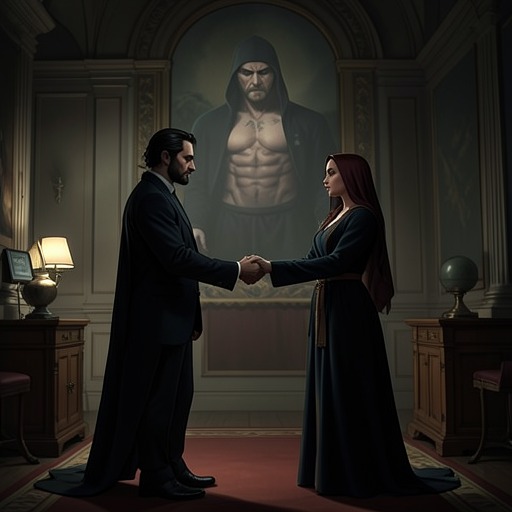
Darilth and Ella's Secret Marriage
The Vampire Prince’s BrideDarilth and Ella's Secret Marriage is the decisive threshold at which Ella leaves behind the social condition imposed on her and becomes Darilth's wife and lifelong mate. The ceremony is secret because Darilth is still in exile and expects to leave Iovis by the following night, while the king's authority stands against their union. Yet the marriage is not presented as a casual escape: it joins personal protection, political defiance, sacred ritual, and the recognition of a bond Darilth already understands as destined.
Causes and Background
Darilth's proposal follows Ella's refusal to accept the only roles his society appears to permit women. He explains that in his world women are either warriors married to men or slaves employed as concubines, and Ella responds that she would rather die than become a slave. Her resistance is intensified by the fact that she has no home or family to return to; the convent was no better than slavery in her experience. Darilth therefore offers her a genuine alternative, promising that he can make an exception for her and set her free if she wishes to go home.
Freedom, however, does not mean returning Ella to a secure life. Darilth tells her that he must leave Iovis by the next night because he remains in exile, then asks whether she would prefer to become his wife. The question converts their immediate danger into a choice about identity and belonging. Ella initially objects that the king would not permit such a marriage, but Darilth rejects that limitation. He declares that he will make her his queen regardless of what the king says or thinks, grounding the decision in his conviction that she is his true mate.
Secret Departure and Ceremony
Darilth acts quickly rather than waiting for official approval. He gives Ella a hooded cloak, puts on his own dark cloak, straps on the sword Lazarus, and leads her through the basement tunnels. Lazarus is not an ordinary weapon: its blade is forged from steel native to Iovis, it is sharp enough to split a feather, and only the heir to the throne may wield it. Its presence makes the journey both intimate and politically charged, marking Darilth as a royal heir even while exile prevents him from exercising ordinary royal authority.
The tunnels are illuminated by blue light and end at sliding metal doors that conceal a vehicle. Darilth straps Ella into a seat before sitting beside her, and the car travels through the complex in every direction—left, right, up, and down. When Ella asks where they are going, Darilth answers that they are getting married. His amused certainty contrasts with her astonishment that the wedding will happen immediately. He tells her they will reach the Rothgar temple within minutes, turning the subterranean escape into a direct passage from secrecy to sacred public form.
The Rothgar Temple Wedding
The Rothgar temple is simple but grand: pristine white columns, white marble floors, a domed ceiling, and unexpected warmth within. At the center of the hall, beside a huge fountain, Ella stands with Darilth while an old man recites incantations she cannot understand even with the translator she is wearing. The setting separates the marriage from the political world that would forbid it. The tunnels belong to concealment and flight; the temple provides a sacred space in which their decision can be recognized.
The ritual asks Darilth whether he will take Ella as his mate for life, and he answers yes. Ella gives the same answer when asked, and her response resolves the uncertainty that surrounded the proposal. She knows in her heart that she has made the right choice. The old man fills a silver cup with water from the sacred fountain. Darilth drinks first, then offers the cup to Ella; the water tastes sweet. He kisses her afterward, and the kiss seals their bond for life.
The ceremony therefore performs several changes at once. Ella is no longer merely a woman being transported away from an institution or a potential concubine resisting enslavement. She becomes Darilth's chosen mate and future queen. Darilth, meanwhile, does not wait for his father's recognition or for the restoration of his political position. He creates a marital bond in the sacred temple while still excluded from legitimate power, making the secret wedding an act of personal sovereignty.
Consequences and Aftermath
The marriage establishes Darilth and Ella's Secret Marriage as more than an elopement. It binds Ella to Darilth for life and gives their relationship a formal sacred foundation before later political struggles can test it. Darilth's promise to make Ella his queen is no longer only a declaration made in private; the temple ritual has enacted the union that his father's authority refuses to acknowledge.
The marriage also reverses the value structure surrounding Ella. Before the ceremony, her future is narrowed to servitude, concubinage, or a return to the convent. Darilth's proposal introduces choice, but the ritual makes that choice durable through the mate-for-life vow, shared sacred water, and sealing kiss. The event consequently links freedom with belonging rather than treating them as opposites: Ella escapes the institutions that controlled her by entering a bond she actively accepts.
Narrative Significance
The event follows a clear separation, threshold, and reintegration pattern. Ella separates from the convent and from the social categories imposed on women; she passes through the hidden tunnels and the uncertainty of an immediate proposal; then she re-enters society under a transformed identity as Darilth's wife and lifelong mate. The temple is a sacred interruption of ordinary political time, allowing the couple to establish a lasting order before the surrounding kingdom is prepared to accept it.
The secret wedding also anticipates the story's later conflict over recognition. Cheryl's public arrival at the palace reveals how royal marriage can be displayed before crowds, with a hovering stone platform carrying her from the temple to the palace and a sea of people chanting her name. Darilth and Ella's union is the opposite image: it is conducted privately, during exile, in a warm white temple reached through underground tunnels. One marriage is ceremonially exposed to the kingdom; the other must first exist beyond the kingdom's permission. Both nevertheless treat marriage as a transfer into a royal role, showing how sacred union can challenge the political structures that claim the right to define it.
The broader narrative repeatedly uses ritual to determine identity and belonging. The Kinai Joining, for example, occurs every twenty-five years for unjoined Kinai men and women older than twenty and younger than thirty, during the winter when the beastlings hatch. Against that communal and cyclical rite, Darilth and Ella's wedding is urgent, clandestine, and individually chosen. Its power comes from taking place outside the approved timetable while still using sacred ceremony to make the bond permanent. In that contrast, the event presents marriage as both an escape from inherited social roles and a claim to a new place within the royal order.